
Balance disorders are very difficult to diagnose and treat because there is often more than one underlying cause. Knowledge of all the sensory systems that contribute to balance as well as how each system works together and interacts with the brain is essential.
How are balance disorders caused?
- Benign Positional Vertigo (BPPV) – BPPV is the number one cause of all dizziness. It involves intense, brief episodes of vertigo associated with a change in the position of your head, often when you turn over in bed or sit up in the morning.
- Vestibular Neuronitis – inflammation of the inner ear
- Ménière’s Disease – a buildup of fluid in the inner ear
- Vestibular Migraine – dizziness and vertigo that may or may not be accompanied by headaches
- Head Trauma
- Multiple Sclerosis
- Stroke and heart attack
- Slow-growing tumors
- Joint and muscle weakness
- High or low blood pressure
- Viral infections
How are balance disorders diagnosed?
- Case History: one of the most important components in diagnosing balance disorders. Details about the imbalance can often determine which part of the inner ear or brain is involved.
- Diagnostic Hearing Evaluation: the hearing system and the vestibular system are very close in physical proximity. They function together. Any part of the ear can cause and/or contribute to a loss of balance.
- Auditory Brainstem Response: tests both the ear and the brain by measuring the timing of electrical waves from the brainstem.
- Voluntary Eye Movement Testing: measures the ability to coordinate eye movements with head movements crucial for walking, driving, etc.
- Videonystagmography (VNG): computerized testing that measures, records and analyzes eye movements under various conditions.
- Computerized Dynamic Posturography (CDP): measures and tracks all of the components (eyes, inner ear, muscles and joints) involved in maintaining balance.
How are balance disorders treated?
Treatment of balance disorders consists of Vestibular Rehabilitation and Balance Retraining. An individual treatment plan is designed for each patient based upon the patient’s history, the findings from the diagnostic testing performed and the functional limitations caused by the imbalance.
The goals of all treatment plans are:
- Decreasing or eliminating dizziness/vertigo
- Improving balance function and safety
- Improving visual motor control and tolerance of motion
- Increasing activity levels
- Reducing falls or risks of falls
Has your hearing aid ever suddenly stopped working? Most often, you might try changing the battery and then wind up coming in to the audiology office for an appointment. During that appointment, have you been told that your hearing aid was just plugged with wax? Well, I know that I have told many patients this in the past. The great news is that you have the ability to unclog your hearing aid at home by changing the wax guard.
What is a wax guard and why is it important?
Depending on the type and style of hearing aid you have, there is a wax guard located at the sound outlet or at the receiver. The wax guard acts as a protective cover to stop ear wax from going deep into the hearing aid. Typically it is a white circle that is located on the portion of the hearing aid that you insert into your ear.
When should I change my wax guard?
The amount of earwax produced by each individual can vary. It is recommended that we check the wax guard daily. If your hearing aid starts to sound weak/silent or wax is visible, it’s time to change the wax guard.
How do I change my wax guard?
First, wipe off any visible wax from the hearing aid, and make sure you have the necessary wax removal sticks to change it at home.

Next, insert the open ended portion of the removal stick into the sound outlet (usually encompassed into a stainless steel bushing), twist, and pull it straight out.
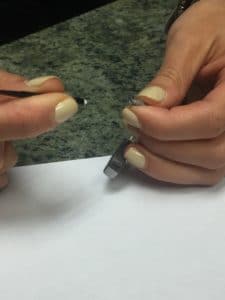

Now, turn the removal stick to the other side (that has the new white end on it) and insert the new white end into the sound outlet and remove. Make sure the wax guard is sitting flat against the stainless steel bushing of the sound outlet.
All that’s left to do is throw out your old wax guard and removal stick, which can’t be reused. And you’re done! Are you hearing better now?
EWWW- EARWAX! DISGUSTING!
So why is everyone so grossed out by ear wax? Well for one, it looks yucky. It’s brown, greenish, gunky and sometimes gooey and sticky. Just seeing it can make you feel unclean and in need of hygiene.
But get over it! Everyone has it. And it’s a good thing you do or you’d be in a lot of trouble. There’s a reason you have ear wax. It creates a waterproof lining in your ears that keeps them dry, which prevents germs and bacteria from causing constant infections. It traps dirt and dust, and little pieces of cotton (from those nasty Q-tips), and all the stuff that gets stuck in the hairspray you accidentally sprayed in your ears. Wax keeps your ears lubricated and repels fungi, insects, and water.
Ear wax has a purpose. It protects your ears.
In fact, having too little earwax or over cleaning your ears can cause dry, flaky and itching ears and trigger infections.
Some wax is dry and flaky and some wax is gooey and sticky. What kind you have is basically genetic. In general, Asians have dry earwax while European and African populations produce “wet” ear wax.
GET THAT Q-TIP, BOBBY PIN, PEN KNIFE, AND SAMURAI SWORD OUT OF YOUR EAR!
Most ears are self cleaning. Every time you chew or talk, the movement of your jaw causes the dusty, germ laden wax to be pushed toward the opening of your ear where it usually flakes and falls out. Meantime, the glands in your ear canals are producing new, protective fresh wax.
When you stick objects in your ear, you’re really not helping. You’re actually pushing all the wax deeper into the canal and causing it to keep building up. Then the wax gets impacted.
- You get hearing loss
- You get an earache
- You get tinnitus (ringing in your ear)
- Your ears itch
- Your ears smell bad
- You puncture your eardrum
THINGS THAT CAN CAUSE EXCESSIVE WAX BUILD-UP:
- The number one cause of excessive wax buildup is self cleaning attempts. See, I told you it was bad.
- Genetics – some people just produce too much. It runs in the family
- Headphones*
- Hearing aids*
- Age – the ears produce less moisture and the ear canals can narrow, causing the dry wax to get stuck.
*Your ears need to breathe and get air. Wearing headphones and using hearing aids can block the ears from performing their natural self-process.
BOTTOM LINE:
Cleaning your ears isn’t a do-it-yourself project. Even if you use an over the counter remedy, how do you know if it worked? You can’t see what you’re doing in there.
If you think you have ear wax build up, do NOT try to fix it yourself. Your audiologist or doctor can remove it quickly, easily, comfortably, and professionally.
Hearing Health Center presents Experience the “TeleCare” Breakthrough featuring Walter Jacobsen
Hearing Health Center presents Dreading the Holidays featuring Walter Jacobsen
“How often should I change my hearing aid batteries?” is one of the most common questions that we get from hearing aid users. Battery manufacturers use an equation to give an estimate; however, there are several factors that determine the battery life of a hearing device.
Battery Types:
Zinc Air is the most common battery type. Zinc air batteries have a tab. When the tab is pulled off, oxygen mixes with zinc oxide and the battery is activated. For best results, it is recommended to wait up to 5 minutes, after pulling the tab off the battery, before inserting the battery into the hearing device.
Rechargeable is another popular option. Though rechargeable batteries are not available with all hearing aids, more manufacturers are starting to offer them as an alternative to zinc air. Rechargeable devices are placed in a charger overnight.
Battery Life:
All hearing aids have an indicator to let you know when your battery life is low and needs to be changed. There are a number of factors that can determine the life of the battery.
Here are just a few:
 Length of wearing time:
The longer the device is being worn, the faster the battery will drain.
 Streaming and remote usage:
The ability to stream phone calls or music is a very popular feature; however, it can drain your battery more quickly.
 Moisture:
Yes, moisture can drain your battery faster as well! You may not sweat and there might not be any humidity in the air, but your hearing aid can still accumulate moisture. It is recommended that hearing devices using zinc air batteries be kept in a hearing aid de-humidifier, such as the Zephyr, overnight to prevent moisture build up and keep your hearing device working in tip top shape!
If you feel as though you are going through batteries faster than you should be, give us a call!
-contributed by Marnie Belfor, Audiology Technician

Americans spend an average of 5 hours per day watching TV. And, if you have any hearing issues, you spend even more time listening to television since you’re not going out and socializing as much…it’s not fun when you don’t know what people are talking about and it can be embarrassing.
Besides, even when you go to the movies or theater, you really don’t enjoy it. And everyone is annoyed when you keep saying, “What?” “What did she say?”
So you stay home watching TV, but you can’t understand what they’re saying half the time and turning up the volume doesn’t help. Especially with Downton Abbey. Who can understand those foreign accents? Then, your spouse and kids complain the TV’s too loud and turn it down!
Imagine clearly hearing and understanding every word on your favorite TV show. Imagine going to a movie, play or drive-thru Starbucks and hearing everything clearly? Imagine going to church or synagogue and actually enjoying the sermon?
With hearing loops, you can! Ever since composer Richard Einhorn, wrote about his experience at Kennedy Center, looping has been taking the country by storm.
“There I was at ‘Wicked’ weeping uncontrollably – and I don’t even like musicals,” he said. “For the first time since I lost most of my hearing, live music was perfectly clear, perfectly clean and incredibly rich.”
Looping is basically just a copper wire placed around a room that’s hooked up to a transmitter that’s connected to the sound source (a microphone, the TV). The wire emits a magnetic signal. Most hearing devices have a tiny coil inside that also emits a magnetic symbol. When the little coil is turned on, the transmitter sends the signal (voice) directly into your hearing devices and voila! You hear everything right into your ears. It’s like magic.
The best part is, besides finally knowing what’s going on, is you don’t have to wear a big bulky headset that announces to the world you can’t hear. And, it’s not isolating. You can hear everything that’s going on and still talk to the person next to you.
When you see this symbol to the left, just touch the button on your hearing devices (or remote control) to activate the coil. Now, sit back and enjoy!
P.S. Even if you don’t have hearing devices, can still enjoy hearing through looping. Just ask to borrow a headset.